Home / Verify License & Insurance
How to Verify a Contractor's License and Insurance (Any State)
Licensing works differently in every state — here's how to check yours, no matter where you live.
Home / Verify License & Insurance
Licensing works differently in every state — here's how to check yours, no matter where you live.
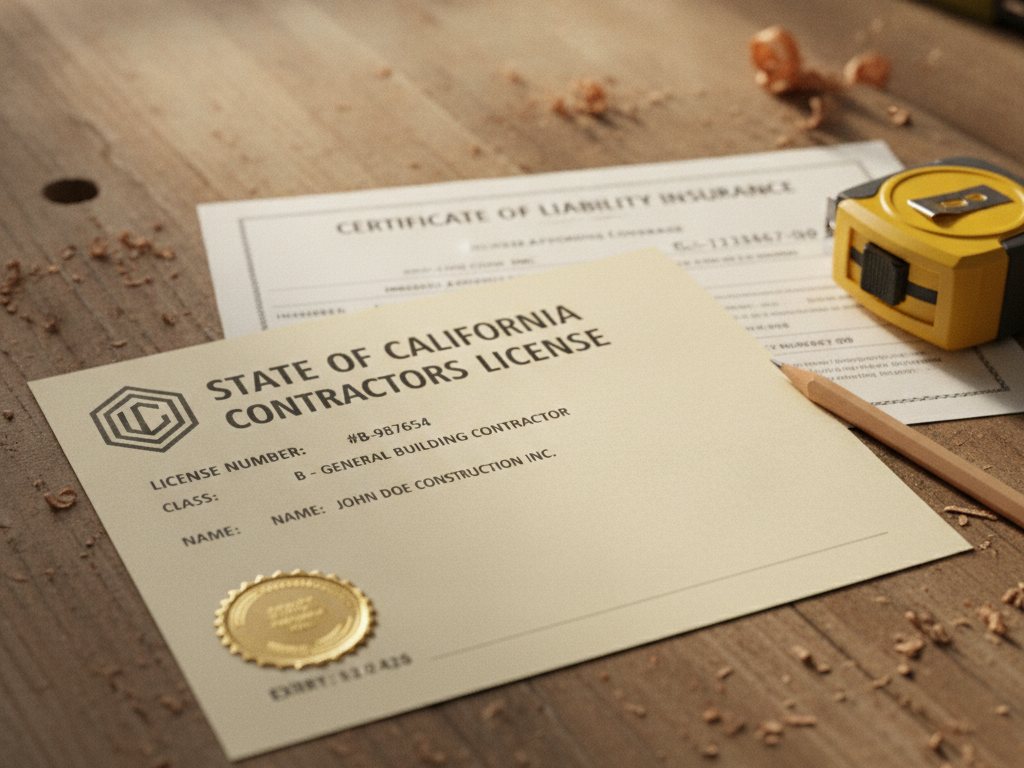
A contractor license is issued by a state (or in some states, by counties or cities) after they demonstrate qualifying experience, pass an exam, and often carry a required bond. It comes with a real license number you can look up — a contractor simply saying "I'm licensed" isn't proof of anything.
A legitimate contractor gives it to you without hesitation, usually printed right on their estimate.
Search "[your state] contractor license lookup" — every state's licensing board runs a free public search.
Check the status is active (not expired, suspended, or revoked) and the business name matches exactly.
Many states issue category-specific licenses — general, electrical, plumbing, roofing. Confirm it covers your project.
Every state licenses contractors through its own agency. These are some of the larger states' licensing boards by name — search "[your state] contractor license lookup" to find yours if it's not listed.
| State | Licensing Board |
|---|---|
| California | Contractors State License Board (CSLB) |
| Florida | Department of Business & Professional Regulation |
| Texas | Texas Department of Licensing and Regulation (for specialty trades) |
| Arizona | Registrar of Contractors (ROC) |
| Washington | Department of Labor & Industries (L&I) |
| Georgia | Secretary of State — Licensing Boards Division |
| North Carolina | Licensing Board for General Contractors |
| Nevada | State Contractors Board |
| Virginia | Dept. of Professional & Occupational Regulation (DPOR) |
| New York | Varies by county/city — most require local licensing |
Two coverages matter for a homeowner: general liability, which covers damage the contractor causes to your property, and workers' compensation, which covers an injury to one of their workers on your job site — without it, you could be held liable if a worker gets hurt at your home. Ask for a Certificate of Insurance (COI) sent directly from their insurance agent, showing active coverage dates, the coverage types, and the contractor's name matching the business you're hiring.
"Can you send me your certificate of insurance and license number before we sign anything? I keep a copy on file for every project."
Any legitimate contractor will send it without pushback. Hesitation is itself a signal worth noting.
They measure completely different things. A Better Business Bureau rating reflects how a business handles complaints filed with a private nonprofit. A state license is a legal qualification issued by a government licensing board. Check both — but never treat one as a substitute for the other.
Every contractor in our network is already verified for license and insurance.
Find a Vetted Contractor Near YouAsk for their license number and search your state's official licensing board lookup tool (search "[your state] contractor license lookup") to confirm it's active. For insurance, ask them to send you a Certificate of Insurance (COI) directly from their insurance agent or carrier — not a photo they hand you — so you can verify it's current and actually covers the work.
A license means the state has verified their qualifications to perform the work and issued them a number you can look up. Insurance is separate — it means they carry a policy (general liability, and workers' compensation if they have employees) that would pay out if something goes wrong on your property. A contractor can technically be licensed without being insured, which is why you check both, not just one.
No — they're not related. A Better Business Bureau rating reflects how a business responds to complaints filed with the BBB, a private nonprofit. A state license is a legal qualification issued by a government agency. A contractor can have an A+ BBB rating and no valid license, or vice versa. Check both, but don't treat one as a substitute for the other.